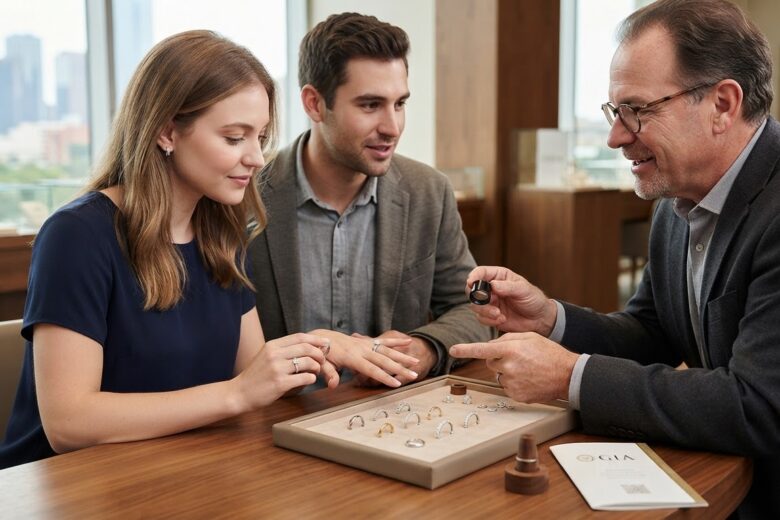
A wedding band is the one piece of jewelry most people wear every day, through office work, gym sessions, and summers on Lake Texoma. That daily exposure makes it a practical purchase as well as a sentimental one. A band that looks striking in a showroom can catch on sweaters, loosen after a few months, or pair awkwardly with an engagement ring. Knowing how metal, profile, stone origin, and pricing interact is the best protection against paying for features that will not hold up.
Shoppers searching for wedding rings dallas face a crowded market of showrooms, online retailers, and custom studios, each with different strengths. Dallas has a large concentration of independent jewelers alongside national chains, so the range of quality and pricing is wide. Comparing options side by side, and asking specific questions about how each band is made and certified, helps separate a sound purchase from an expensive one.
Before visiting any jeweler, decide what matters most: exact fit, a specific design, a stone with documented grading, or the lowest total cost. Those priorities will shape nearly every choice that follows. A consultation with a jeweler such as Shapiro Diamonds Dallas Engagement Rings can be useful for comparing design options and sourcing details, but the strongest buying decisions come from understanding the trade-offs first.
Custom Design or Ready-Made: Deciding How Your Band Gets Made
Ready-made bands are produced in standard sizes and profiles, usually in batches from a manufacturer’s catalog. They are typically available the same day or within a few days, and prices are predictable because the design costs are spread across many units. The drawback is limited variation. A standard band may not match the curve of an engagement ring or the width of a finger, and resizing can alter the shape of pavé or channel-set stones.
Made-to-order bands start from a wax or CAD model. The jeweler carves or prints a wax pattern, casts it in the chosen metal, sets the stones, and polishes the piece. Lead times commonly run several weeks, and custom work often carries a design fee in addition to materials and labor. The advantage is control over width, comfort profile, stone placement, and how the band interacts with an existing setting. For couples with an unusual finger shape, a sculpted engagement ring, or a family stone being reset, custom work is often the only way to get a precise fit.
A useful test is to ask whether the band needs to do something a catalog piece cannot. If the answer is no, a ready-made band may offer better value. If the design must match a specific ring or incorporate a meaningful stone, the premium for custom work is usually justified.
Natural vs. Lab-Grown Diamonds in Wedding Bands
Natural and lab-grown diamonds share the same chemical composition, crystal structure, and optical properties. The difference lies in origin and market value. Lab-grown stones are typically priced far below natural stones of comparable grade, often by a large margin. For a band that will be worn daily, that gap can make a larger carat weight or higher-quality metal affordable. The trade-off is resale value: natural diamonds have historically retained more of their secondary-market value than lab-grown stones, which have a more volatile and generally lower resale market.
Visual character is not a reliable differentiator at retail levels. Both types can show excellent brilliance and fire when properly cut. The more important question is whether the stones are accurately described and independently graded.
A grading report should include the laboratory name, report number, shape and measurements, carat weight, color grade, clarity grade, cut grade where applicable, polish and symmetry, and fluorescence. Reputable laboratories include the Gemological Institute of America (GIA) and the International Gemological Institute (IGI). Lab-grown stones are also graded by these laboratories, and the report should state clearly that the stone is laboratory-grown.
To verify a report, look up the report number on the issuing laboratory’s website, compare the listed measurements and weight with the stone itself, and confirm that the inscription on the girdle matches the report when the lab offers laser inscription. A 10x loupe helps you check for obvious inclusions, though it cannot replace a professional examination. Be cautious of reports from unfamiliar laboratories with no verifiable lookup system.
Metals, Profiles, and Fit: Matching a Band to an Engagement Ring
Metal choice affects durability, color, and cost. Platinum 950 is dense, hypoallergenic, and holds prong tension well, but it costs more than gold and develops a patina over time that some wearers prefer and others do not. Fourteen-karat gold (585 parts per thousand) is harder than 18-karat and more resistant to scratching, making it a practical choice for daily wear. Eighteen-karat gold has richer color and a higher gold content, but it is softer and more prone to wear on the inner surface. Palladium is lighter than platinum and costs less, though it can be harder to resize.
Band width and profile determine comfort and appearance. A flat or comfort-fit profile, with an inner curve that follows the finger, feels more natural than a flat interior. Widths between 2 mm and 4 mm are common for women’s bands, while men’s bands often range from 4 mm to 6 mm. Narrow bands are easier to stack but can feel thin under a large stone.
Whether the band sits flush against the engagement ring depends on the engagement setting’s height and the band’s curvature. A high-set solitaire will rarely sit flush against a flat band, leaving a gap that may catch on fabric. Bands can be ordered with a notched or curved edge to fit a specific engagement setting. Bring the engagement ring to every fitting, and ask the jeweler to check the gap with the rings together, since measuring one ring alone is not enough.
Stacking With an Existing Engagement Ring
When a band will sit beside a set stone, consider three factors: height, curvature, and spacing. Height determines how far the engagement stone rises above the finger, and the band must clear that height or the setting will prevent the two rings from meeting. Curvature determines how well the bands nest. Spacing matters when a band has stones; closely set pavé or channel stones can make the engagement ring’s prongs sit awkwardly.
Ask for a wax model or 3D rendering before final casting when the design depends on precise fit. Jewelers can also reduce the band’s height at the contact point so it sits lower against the engagement ring.
Comfort and Daily Wear
Daily wear raises several practical concerns. Prongs wear down, and exposed prongs can snag on clothing or hair. Bezel or semi-bezel settings protect the stone’s edges and reduce snagging, though they admit less light. Channel-set stones are secure but can collect debris. Pavé settings maximize sparkle but require periodic inspection.
Plan for maintenance. Have prongs and settings checked every six months, and clean the band with warm water, mild dish soap, and a soft brush. Avoid chlorine, which can damage gold alloys, and remove the ring during heavy physical work. Dallas’s heat and humidity can cause hands to swell in summer, so consider whether the band should be sized for a comfortable fit during warmer months.
Where Diamond Prices Come From and How to Judge a Deal
Diamond pricing is driven by the four Cs: carat, cut, color, and clarity. Carat weight has the largest effect, and prices rise sharply at round-number thresholds such as 0.5, 1.0, and 2.0 carats. Cut affects brilliance and is typically the most important factor for visual appeal. Color grades near colorless (D through F) cost more than near-colorless grades (G through J), though the difference is often less visible in a set band than on a loose stone. Clarity grades matter most when inclusions are visible to the naked eye.
Markups vary widely. Retail markups on natural diamonds can be substantial, and some jewelers add margin on metal, labor, design fees, and setting work. Custom studios that source directly may reduce some of these costs, but they also charge for design time and craftsmanship.
To compare quotes fairly, request the same specifications from each jeweler: carat weight, color, clarity, cut grade, metal type and karat, band width, and total stone count. Ask for itemized pricing separating stones, metal, labor, and design. Confirm whether the quote includes Texas sales tax, which in Dallas is 8.25 percent. Be wary of urgency tactics, such as offers that expire the same day, and of quotes that cannot be compared because the specifications differ.
Realistic benchmarks help frame expectations. Simple gold bands without stones often range from a few hundred dollars to around $1,500, depending on metal and width. Bands with a modest diamond pavé setting can range from about $1,500 to $4,000 or more for natural stones, with lab-grown options often costing substantially less for the same visual effect. Full custom designs with platinum and multiple stones can exceed these ranges.
Questions to Ask Before Commissioning a Band in Dallas
Any jeweler, whether a showroom or a studio, should be able to answer the following clearly:
- Where are the diamonds sourced, and are natural and lab-grown stones clearly identified?
- Which laboratories issue the grading reports, and can you verify report numbers online?
- Is the band cast, handmade, or 3D-printed, and who performs the setting?
- What is the design process, including how many revisions are included and whether a wax or digital model is shown before casting?
- What is the expected lead time from approval to delivery, and what happens if the schedule slips?
- What are the resizing and repair policies, including whether resizing is limited for pavé or eternity bands?
- Does the quote include metal, labor, design, setting, and tax?
- What warranty covers stone loss, prong repair, and finish?
A proper consultation should involve examining the stones or reports, discussing the band’s fit with the engagement ring, and reviewing the total cost in writing. If a jeweler cannot provide documentation or rushes the decision, that is a meaningful signal. Taking time to compare two or three jewelers, with the same specifications in hand, is usually the most reliable way to avoid overpaying without giving up the design you want.
 Ryan Thorne
